You’ve noticed it in photos. During tummy time. Maybe when you’re feeding your baby or watching them sleep.
Their little head always seems to turn the same way.
At first, you thought it was just a preference. Maybe they like looking towards the window, or perhaps that’s simply their favourite side.
But then you start noticing other things.
They seem uncomfortable turning their head in the opposite direction. One side of tummy time looks easier than the other. Perhaps they always settle better when held on a particular side.
And now you’re wondering:
Is this normal? Is it something they’ll grow out of? Or is their little body trying to tell you something?
Babies develop their own movement patterns from the very beginning. But when a head-turning preference becomes persistent, particularly when it’s accompanied by restricted movement or an obvious head tilt, it’s worth understanding what might be happening.
Because those tiny movements of the head and neck are part of a much bigger developmental picture.
Why Babies Develop a Favourite Side
In the first few months of life, babies are learning an extraordinary number of new skills.
They’re discovering how to lift their heads, turn towards familiar voices, follow interesting objects with their eyes and gradually gain control over their movements.
And all of this takes coordination.
The muscles of the neck must work together to support the head, while sensory information from the muscles and joints helps the nervous system understand where the head is positioned.
Early movements may look wobbly and uncoordinated, but they’re an important part of developing strength and control.
It’s also common for young babies to show some preference for looking in one direction.
Sometimes it’s related to their environment. Perhaps the most interesting things in the room are always on the same side.
Sometimes it reflects their position in the cot, pram or while being held.
But occasionally, a persistent preference is associated with a physical restriction that makes turning in one direction more difficult.
The important distinction isn’t simply whether your baby has a favourite side. It’s whether they can comfortably and actively move their head in both directions.
When a Head-Turning Preference Might Be Torticollis
One condition associated with a persistent head tilt or turning preference is congenital muscular torticollis.
Torticollis describes a position in which the head tilts towards one side, often with the chin turned towards the opposite shoulder.
In babies with congenital muscular torticollis, one of the neck muscles, called the sternocleidomastoid or SCM, may be shortened or tighter than expected.
This muscle runs along the side of the neck and plays an important role in head movement.
When its movement is restricted, you might notice that your baby:
- Consistently tilts their head towards one shoulder
- Prefers looking in one direction
- Has difficulty turning their head fully to the opposite side
- Seems less comfortable in certain feeding or holding positions
- Shows asymmetry in their head or neck position
- Has developed some flattening on one side of their head
Not every head-turning preference is torticollis, and not every baby with torticollis has the same presentation.
There are also other possible causes of unusual head positioning, including visual, neurological and skeletal conditions.
That’s why a persistent head tilt or restriction should be assessed rather than assumed to be a harmless preference.
The earlier a genuine movement restriction is recognised, the sooner appropriate assessment and management can begin.
What Does Birth Have to Do With Neck Movement?
Think about the physical journey a baby makes during pregnancy and birth.
For months, they’re growing within a relatively confined space, gradually changing position as they develop.
Some babies spend their final weeks in positions that influence how their head, neck and body are held.
Birth then introduces an entirely new environment, where babies begin moving against gravity and developing independent control of their heads and bodies.
A baby’s position before birth and certain birth circumstances may be relevant when clinicians assess congenital muscular torticollis.
However, a caesarean section, assisted birth or long labour doesn’t automatically mean a baby has experienced a neck injury.
And a difficult birth history alone cannot tell us whether a baby has restricted movement.
At Coast Family Chiropractic, we ask about pregnancy and birth because they’re part of understanding a baby’s developmental and physical history.
But it’s the baby’s current presentation and examination findings that guide decisions about their musculoskeletal health.
The goal isn’t to find something that went wrong during birth.
It’s to understand how your baby is moving now.
Why Head and Neck Movement Matters for Development
Your baby’s head and neck have an important job.
In the early weeks, their movements are largely supported by developing reflexes and emerging muscle control.
As they grow, they gradually learn to lift their head, turn towards sounds and sights, and maintain increasingly stable positions.
These skills form part of the foundation for later movement.
During tummy time, for example, babies practise lifting and turning their heads while using their shoulders, arms and upper body for support.
As their control develops, they begin reaching, rolling and exploring the world from different positions.
The nervous system is constantly processing information from muscles, joints, vision and the vestibular system, which contributes to balance and spatial orientation.
One important part of this process is called proprioception.
Proprioception is the body’s ability to sense the position and movement of its different parts.
Sensory receptors in muscles and joints provide information that helps the brain coordinate movement.
And the neck is one of the areas that contributes to this sensory feedback.
When a baby has restricted neck movement, it may influence how easily they look, turn and explore in different directions.
That doesn’t mean a neck restriction will necessarily cause developmental delays or neurological difficulties.
But comfortable movement in both directions is an important part of early physical development.
Those little head turns aren’t just cute moments. They’re part of your baby’s growing ability to move and explore their world.
Could a Head Preference Affect Your Baby’s Head Shape?
Have you noticed a slightly flattened area on the back or side of your baby’s head?
This is sometimes called positional plagiocephaly.
A baby’s skull is relatively soft and continues to grow and change shape during infancy.
When a baby consistently rests with pressure on the same area of the head, some flattening can develop.
A persistent head-turning preference or torticollis may contribute to this pattern.
You might notice that one side of the back of the head looks flatter, or that the ears appear slightly asymmetrical when viewed from above.
Positional plagiocephaly is different from craniosynostosis, a condition involving premature fusion of skull sutures, so unusual head shapes need appropriate clinical assessment.
And while parents often worry about head shape, the important thing is to understand what’s contributing to the asymmetry.
If your baby consistently turns in one direction because neck movement is restricted, simply encouraging them to look the other way may not be enough.
They may need a more specific assessment of their neck movement and head position.
Importantly, babies should always be placed on their backs for sleep, even when they have a head-turning preference or positional flattening.
Tummy time is for when babies are awake and supervised, not for sleeping.
What About Feeding Difficulties?
Sometimes parents first notice a head-turning preference during feeding.
Perhaps their baby seems more comfortable feeding on one side.
Or they become unsettled when positioned in a way that requires turning their head towards the less preferred direction.
Feeding is a complex activity involving positioning, coordination, breathing and swallowing.
A baby with restricted neck movement may find certain positions less comfortable.
But feeding difficulties can have many different causes, and a head-turning preference doesn’t automatically explain problems with latching, sucking or swallowing.
At Coast Family Chiropractic, understanding a baby’s feeding and positioning history can provide useful context when considering their musculoskeletal function.
The focus is on whether there are physical movement restrictions or postural findings relevant to the baby’s presentation.
It’s another reason to look carefully at how your baby moves, rather than assuming every feeding challenge has the same explanation.
What Can Parents Look Out For?
You don’t need to be an expert in anatomy to notice how your baby moves.
You’re the person who sees them throughout the day, during feeding, cuddles, playtime and those quiet moments when they’re looking around the room.
Here are some things worth paying attention to:
1. Does your baby consistently look in one direction?
An occasional preference is common, but a persistent pattern may deserve closer attention.
2. Can they turn their head both ways?
Notice whether they actively look towards interesting sights or sounds on either side.
3. Is there an obvious head tilt?
Does one ear seem consistently closer to the shoulder, even when your baby is relaxed?
4. Do they seem uncomfortable in certain positions?
Watch for differences in how they respond when held, fed or positioned for supervised play.
5. Is there any noticeable flattening of the head?
Changes in head shape can sometimes occur alongside persistent positioning preferences.
6. Are their movements becoming more symmetrical as they develop?
During supervised tummy time and play, notice how they lift their head, turn and gradually use both sides of their body.
These observations aren’t a way to diagnose torticollis at home.
They’re simply useful details to share during an assessment.
A persistent tilt, significant restriction or developing head asymmetry warrants timely assessment by an appropriately qualified clinician. Sudden-onset head tilt, particularly with pain, fever, injury, vomiting or other concerning symptoms, needs prompt medical attention.
How Coast Family Chiropractic Approaches Infant Movement
At Coast Family Chiropractic, we’re particularly interested in understanding spinal movement, posture and musculoskeletal function through different stages of development.
And when it comes to babies, that means taking an age-appropriate, individualised approach.
We begin by listening to your observations.
When did you first notice the head preference? Does your baby turn comfortably in both directions? Have you noticed any changes during tummy time, feeding or everyday positioning?
We also consider pregnancy, birth and early developmental history.
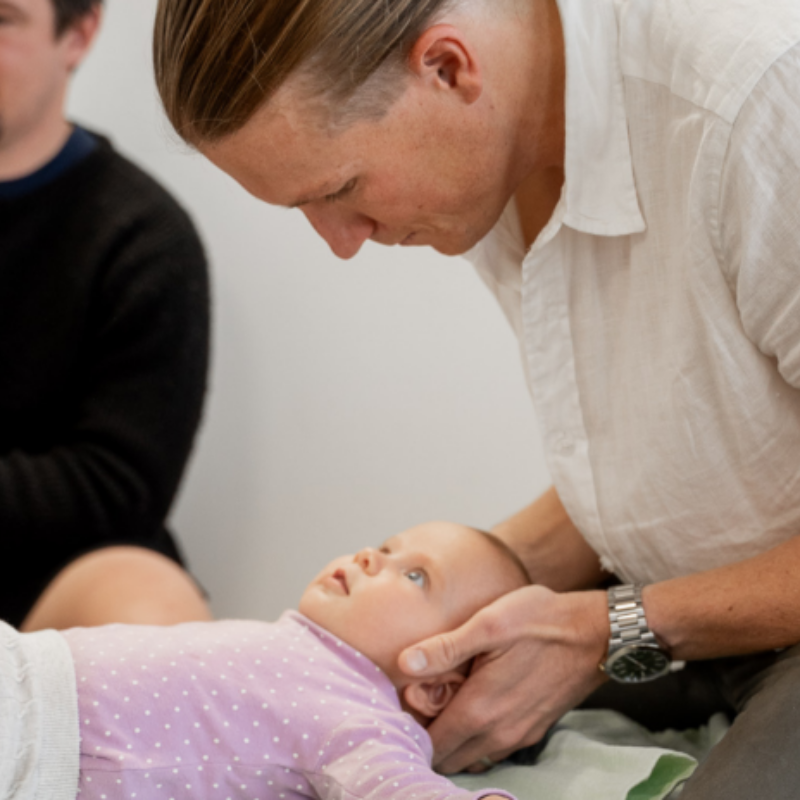
From there, an appropriate physical assessment may include observations of head position, active neck movement, posture and other relevant musculoskeletal findings.
The purpose is to understand the baby’s presentation and determine what is appropriate and safe.
It’s important to recognise that chiropractic adjustments are not an established treatment for congenital muscular torticollis or positional plagiocephaly, and spinal manipulation should not be presented as a way to correct these conditions.
For babies with suspected torticollis, early assessment and evidence-based management, particularly paediatric physiotherapy, can be important.
At Coast Family Chiropractic, we focus on identifying relevant musculoskeletal findings, understanding the limits of chiropractic care and making appropriate clinical decisions for each child.
Because babies aren’t simply smaller versions of adults.
Their bodies are developing rapidly, and their care needs to reflect that.
Small Movements. Important Milestones.
One of the most remarkable things about watching a baby grow is how quickly the smallest movements become bigger achievements.
That first little head lift during tummy time.
The moment they turn towards your voice.
The determined effort to reach for a favourite toy.
The excitement of rolling over for the first time.
Every stage brings new opportunities for movement and exploration.
And while every baby develops at their own pace, being able to move comfortably and explore different positions is an important part of early physical development.
If you’ve noticed your baby consistently tilting their head, favouring one side or having difficulty turning in a particular direction, it’s worth having that movement assessed.
Not because something must be seriously wrong.
But because understanding what’s happening is better than guessing.
Sometimes the smallest movements are the ones worth paying attention to.
Have You Noticed Your Baby Favouring One Side?
At Coast Family Chiropractic, we understand how many questions can come with those early months of parenting.
Our team takes time to listen to your concerns, understand your baby’s developmental history and assess relevant spinal and musculoskeletal findings within our scope of practice.
If you’re concerned about a persistent head tilt or limited neck movement, arrange an assessment with an appropriately qualified health professional so the cause can be identified and suitable management considered.
For questions about Coast Family Chiropractic’s infant musculoskeletal assessment services, you’re welcome to get in touch with our team.
Because understanding how your baby moves is an important part of understanding their physical development.