Your child’s stomach hurts.
The tears come.
By Monday morning, you’re standing at the front door watching them fall apart, already anticipating how difficult the school drop-off might be.
You’ve heard lots of explanations.
“It’s anxiety.”
“It’s just a phase.”
“They’ll get used to it.”
Sometimes you’ve even been told they simply need to push through it.
But as a parent, you know your child.
When school refusal becomes a repeated pattern, it’s worth looking beyond behaviour alone and asking what else might be contributing to how they’re coping.
Looking Beyond Behaviour
School refusal is a complex issue.
For some children, it develops alongside anxiety.
For others, it may be influenced by learning differences, bullying, sensory challenges, social difficulties, physical health concerns, family circumstances, or emotional wellbeing.
There is rarely one single cause.
Rather than asking, “Why won’t they go to school?”, it can sometimes be more helpful to ask, “What is making school feel so difficult for them?”
That shift in perspective often changes the conversation from discipline to understanding.
When the Body Feels Overwhelmed
Many parents describe their child experiencing:
- stomach aches before school
- headaches
- tearfulness
- racing heart
- difficulty sleeping
- overwhelming worry
- emotional outbursts before leaving home.
These experiences are genuine.
They are not simply “attention seeking” or a lack of motivation.
During periods of heightened stress, the body’s autonomic nervous system becomes more active, preparing us to respond to perceived challenges.
This is a normal protective response.
For some children, however, this stress response may be triggered more easily or take longer to settle.
Understanding the Nervous System
The autonomic nervous system helps regulate many automatic body functions including breathing, heart rate, digestion and the body’s response to stress.
It is commonly described as having two broad branches:
- the sympathetic nervous system, which supports alertness and prepares the body to respond to challenge
- the parasympathetic nervous system, which supports rest, recovery and regulation.
Healthy nervous systems move flexibly between these states throughout the day.
When adaptability is reduced, children may find everyday situations more physically and emotionally demanding.
This doesn’t mean their nervous system is “broken.”
It means it may be working very hard to manage the demands being placed upon it.
The Gut-Brain Connection
Many parents notice that emotional stress and digestive symptoms seem to occur together.
This relationship is well recognised through the gut-brain axis.
The vagus nerve is one of the major communication pathways between the brain and digestive system and contributes to functions including digestion, heart rate regulation and aspects of emotional regulation.
While stomach aches before school are common in anxious children, they can have many possible causes.
Understanding the interaction between the brain, gut and nervous system can help explain why emotional stress is often experienced physically.
Every Child’s Story Is Different
Some children seem naturally more adaptable to change.
Others have experienced greater physical, emotional or developmental challenges throughout early life.
Many factors may influence how children respond to stress, including:
- temperament
- developmental differences
- sleep quality
- illness
- sensory preferences
- family stress
- significant life events
- physical health.
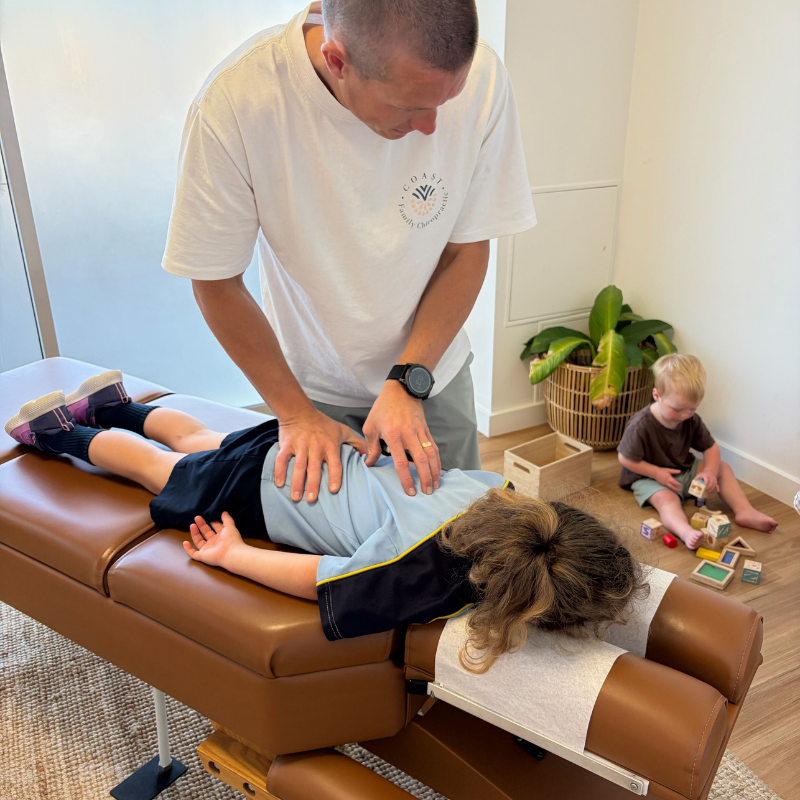
From a chiropractic perspective, we also consider how spinal function and nervous system regulation may contribute to a child’s overall adaptability.
Rather than searching for one cause, we look at the whole picture.
Understanding How the Nervous System Is Adapting
At Coast Family Chiropractic, we use INSiGHT Scans as part of our clinical assessment.
These include:
Heart Rate Variability (HRV)
Provides information about autonomic nervous system adaptability and physiological regulation.
Surface EMG
Measures muscle activity alongside the spine and provides information about muscle activation patterns.
NeuroThermal Scanning
Measures skin temperature patterns alongside the spine that may provide additional information about autonomic nervous system activity.
These assessments do not diagnose anxiety, school refusal or other medical conditions.
Instead, they contribute to our understanding of how a child’s nervous system may be adapting alongside a thorough history and physical examination.
Your Child Isn’t Choosing a Hard Time
If school mornings have become one of the hardest parts of family life, know that you’re not alone.
Many families experience periods where school attendance becomes emotionally overwhelming.
Taking time to understand how your child’s nervous system is adapting may provide another perspective alongside the strategies and supports you’re already using.
At Coast Family Chiropractic, we use INSiGHT Scans and gentle chiropractic care to assess and support nervous system function.
If you’d like to learn more, we’d love to talk with you about whether chiropractic assessment is appropriate for your family. of life.