If you’re reading this, you’ve probably lived this journey.
The late-night searching.
The appointments.
The assessments.
The waiting lists.
The second opinions.
Then finally, someone gives your child a diagnosis.
Perhaps it’s autism.
ADHD.
An anxiety disorder.
A developmental or learning difference.
For many parents, that moment brings two emotions at once.
Relief.
And grief.
Relief because you finally have an explanation for what you’ve been seeing.
Grief because you’re suddenly imagining a future that looks different from the one you expected.
Both feelings are completely understandable.
A Diagnosis Can Be Helpful
Receiving a diagnosis is not inherently a good or bad thing.
For many families, it opens important doors.
It may provide access to:
- school supports and learning adjustments
- funding for therapies
- disability services
- specialist programs
- community support
- a better understanding of your child’s needs.
Perhaps most importantly, it validates what many parents already knew:
Something wasn’t quite right, and it wasn’t because of poor parenting.
That validation matters.
A Diagnosis Is Only Part of the Story
A diagnosis helps describe a collection of characteristics or experiences.
It doesn’t fully describe your child.
Your child is still:
- curious
- funny
- creative
- capable
- growing
- learning
- adapting.
Sometimes families understandably begin seeing every behaviour through the lens of the diagnosis.
Sometimes schools do.
Sometimes health professionals do.
That’s why it’s important to remember that a diagnosis should inform support—not define identity.
Children Continue to Grow and Develop
One of the most encouraging things we know about child development is that children’s brains continue developing throughout childhood and adolescence.
Skills develop.
Confidence grows.
Coping strategies improve.
Support systems become stronger.
Every child follows a different path.
A diagnosis doesn’t tell us what your child’s future will look like.
It simply helps us understand where they are today.
Looking Beyond the Label
Children are complex.
Their wellbeing is influenced by many different factors, including:
- physical health
- sleep
- emotional wellbeing
- family relationships
- learning environment
- sensory experiences
- movement
- nutrition
- nervous system function.
Rather than asking,
“How do we treat this diagnosis?”
it can sometimes be more helpful to ask,
“What does this particular child need to thrive?”
That subtle shift keeps the focus on the child rather than the label.
The Nervous System Is One Part of the Picture
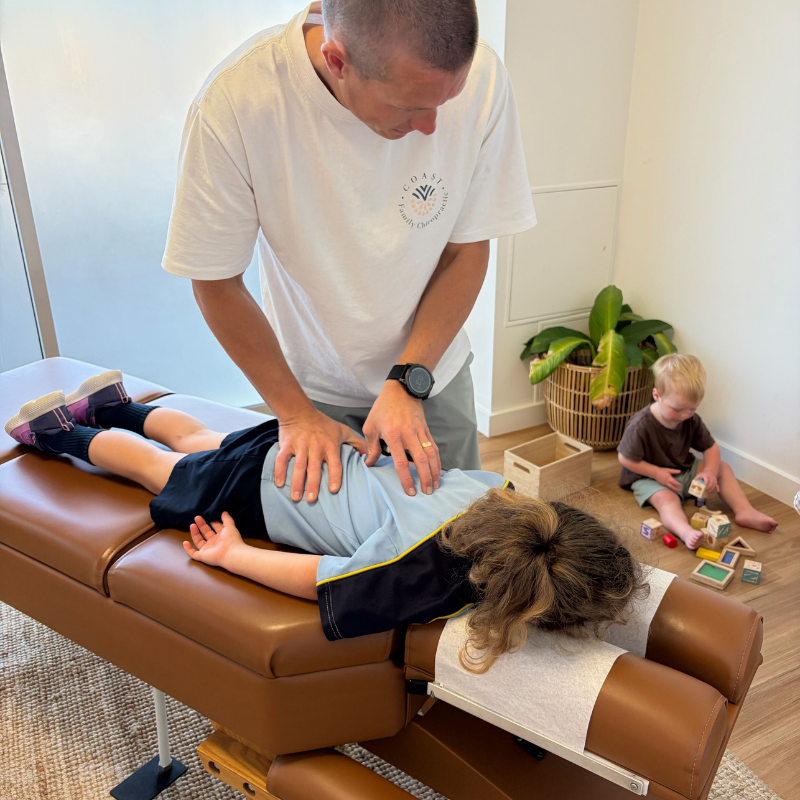
At Coast Family Chiropractic, we look at one aspect of health that may not always be explored in depth: how the nervous system is functioning.
The nervous system helps coordinate communication throughout the body and plays an important role in movement, posture, sensory processing, emotional regulation and adaptation to everyday stress.
This doesn’t mean nervous system function explains every diagnosis.
Nor does it mean chiropractic care replaces medical, psychological or educational support.
Rather, it is one additional perspective that may contribute to understanding how a child is adapting.
Understanding Nervous System Function
As part of our assessment, we use INSiGHT Scans to measure aspects of nervous system function, including:
- Heart Rate Variability (HRV)
- Surface EMG
- NeuroThermal scanning.
These scans provide information about physiological patterns that we consider alongside your child’s history and physical examination.
They do not diagnose autism, ADHD, anxiety or other developmental conditions.
Instead, they help us understand how your child’s nervous system may be functioning at the time of assessment.
Your Child Is So Much More Than a Diagnosis
A diagnosis can explain some of your child’s challenges.
It can help guide support.
It can open doors.
But it should never define who they are or what they’re capable of becoming.
Children continue to learn, develop and surprise us throughout their lives.
The goal isn’t to erase a diagnosis.
The goal is to help every child reach their own potential.
Looking at the Whole Child
At Coast Family Chiropractic, we believe every child deserves to be seen as a whole person—not simply as a diagnosis or a list of symptoms.
If you’d like to better understand how your child’s nervous system is functioning, we’d love to talk with you about whether chiropractic assessment may be appropriate.y. It is more understanding, support, and awareness during a very important season of life.