Before you try another supplement, another sensory tool, another breathing app or another strategy hoping this will finally be the thing that helps your child regulate — let’s talk about something that can easily get missed.
Regulation techniques and nervous system function aren’t the same thing.
Breathing exercises, movement, sensory tools and calming routines can all be useful ways to help children settle and regulate.
But if you keep finding that your child can calm temporarily, only to quickly return to the same patterns of stress and reactivity, it may be worth asking a different question:
What does their nervous system function actually look like?
At Coast Family Chiropractic, that’s where we start.
We See This Pattern All the Time
Nervous system regulation is everywhere right now.
Breathwork. Yoga. Sensory tools. Meditation. Cold exposure. Diet. Supplements. Calming routines.
And we’re genuinely glad families are talking more about the nervous system.
But we also hear a familiar story from parents:
“We’ve tried everything, and nothing seems to stick.”
Maybe you’ve experienced something similar.
You find something that seems to help your child settle. For a while, things feel easier. Then another busy week, poor night’s sleep or change in routine comes along and suddenly it feels like you’re back where you started.
It doesn’t necessarily mean the strategy was useless.
But it may mean there’s more to understand about the way your child’s nervous system is functioning and adapting.
Regulation vs Function: What’s the Difference?
This is an important distinction.
Nervous system regulation describes the nervous system’s ability to respond and adapt appropriately to what’s happening around us.
Practices such as slow breathing, movement, relaxation and sensory activities can influence our physiological state and may help us move towards a calmer state.
Nervous system function is a broader picture.
It involves the constant flow of information between the brain, spinal cord and body, and the way the nervous system receives, processes and responds to that information.
At Coast, we’re particularly interested in the neurospinal system — the relationship between the spine and nervous system, and the sensory information continually travelling between them.
Within chiropractic, we use the term subluxation to describe changes in neurospinal function that may affect the way this information is processed and the way the body responds and adapts.
So rather than simply asking:
“What can we do to make this child feel calm?”
we’re also asking:
“What patterns can we identify in the way their neurospinal system is functioning?”
That’s a very different starting point.
Think of It Like This
Imagine the nervous system as a sophisticated communication network.
A breathing exercise is one piece of information entering that network.
Movement is another.
Sleep, sensory input, physical activity, emotional stress and the environment are all continually adding information too.
The nervous system’s job isn’t simply to be calm.
Its job is to receive that information, interpret it and produce an appropriate response.
Sometimes activation is exactly what’s needed.
A child running onto a football field doesn’t need their nervous system to be deeply relaxed. They need it alert, responsive and ready to move.
Later, when the activity is over, we’d expect the system to be able to shift gears again.
That’s why at Coast we talk less about trying to make the nervous system “calm” all the time and more about adaptability.
Can it respond appropriately to demand?
Can it shift states?
And what patterns do we see when we assess how it’s functioning?
Your Body Learns From Experience
Our nervous systems are continually shaped by experience.
Physical stress. Lack of sleep. Illness. Injury. Emotional stress. Sensory input. Movement. Our environment.
The nervous system responds and adapts to all of it.
When we’re exposed to stress, activation of the sympathetic nervous system helps prepare the body to respond. Heart rate may increase. Muscles become ready for action. Attention changes.
That’s normal physiology.
Once the immediate demand has passed, we’d expect the nervous system to be capable of shifting again towards rest, recovery and other physiological states.
Sometimes, however, patterns of heightened activation can persist.
That doesn’t mean stress is physically “stored” in a particular vertebra or muscle, or that someone is permanently stuck in fight-or-flight.
But it does mean that patterns of nervous system activity and adaptation are worth paying attention to.
Particularly when parents are noticing that their child seems to move quickly into a heightened state and has difficulty shifting back out of it.
The “Perfect Storm”: Looking at the Whole Story
One of the concepts we use at Coast is the Perfect Storm.
It’s not about blaming one event for everything that’s happening with a child.
Instead, it’s a way of stepping back and looking at their whole history rather than viewing each experience in isolation.
That history may include:
- Pregnancy and prenatal factors — including significant physical or emotional stress during pregnancy
- Birth history — including the length and nature of labour and whether interventions such as forceps, vacuum extraction or Caesarean birth were involved
- Early development — including feeding, sleep, movement and developmental milestones
- Illness, injury and physical stress
- Sensory experiences and environmental demands
- Sleep and recovery
- School, sport and everyday emotional stress
None of these things automatically means a child has nervous system dysfunction.
And we don’t look at a Caesarean birth, difficult pregnancy or stressful period and declare that we’ve found “the cause”.
Instead, the history gives us context.
It helps us understand what that child’s developing nervous system has experienced and gives us information to consider alongside what we find during their assessment.
We’re interested in the pattern, not just one event.
When “Calm” Doesn’t Seem to Last
There are times when parents become curious about their child’s nervous system because they notice patterns such as:
- Their child finds it difficult to settle after becoming highly stimulated
- Small changes or demands seem to produce a big response
- Transitions can be particularly challenging
- They appear to move quickly from settled to overwhelmed
- Calming strategies seem helpful in the moment, but the effect doesn’t seem to last
- Sleep, busy periods or changes in routine seem to noticeably influence how well they cope
These observations don’t diagnose nervous system dysfunction.
Children are individuals, and behaviour is influenced by many things.
But they can be useful pieces of information when we’re taking a child’s history and looking at the broader picture of how they are functioning.
This Is Where We Measure
One of the things we feel strongly about at Coast is that we shouldn’t simply assume what’s happening within someone’s nervous system based on how they look or feel.
We assess.
Our Neurological INSiGHT Scans provide information about patterns associated with autonomic activity, muscle activity and temperature along the spine.
Depending on the assessment, this may include:
Heart Rate Variability (HRV) — providing information about variation between heartbeats and aspects of autonomic activity.
Surface electromyography (sEMG) — measuring patterns of muscle activity along the spine.
NeuroThermal scanning — measuring temperature patterns along the spine.
These scans don’t diagnose anxiety, behavioural conditions, sensory disorders or other medical conditions.
They’re used alongside a detailed history and chiropractic examination to give us additional information about nervous system and neurospinal function.
That gives us something more objective to work with than simply saying, “they seem stressed.”
Where Neurologically Focused Chiropractic Care Comes In
Our role at Coast isn’t to teach your child another regulation technique.
We take a neurologically focused approach to chiropractic care.
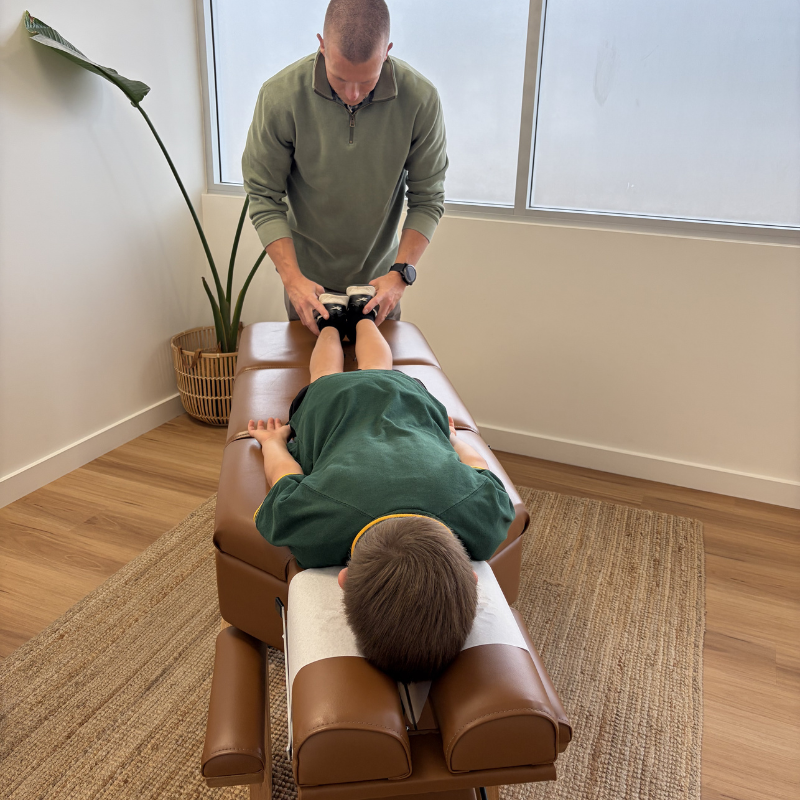
That means assessing the spine and nervous system, identifying patterns of altered neurospinal function and determining whether chiropractic care is appropriate.
Where it is, gentle and specific chiropractic adjustments are tailored to the individual and their assessment findings.
We can then reassess aspects of neurospinal function over time rather than basing everything on how someone happened to feel on the day.
That’s an important distinction.
We’re not promising that an adjustment will make a child calm.
We’re interested in something broader:
How is their neurospinal system functioning, and what can we objectively observe through assessment?
You Can’t See the Whole Nervous System From the Outside
Breathing exercises can be useful.
Movement can be useful.
Sensory activities can be useful.
Sleep, nutrition and everyday routines matter too.
But none of these things tells you, on its own, how your child’s neurospinal system is functioning.
That’s why when families tell us they’ve tried every nervous system “hack” they can find online and still feel as though they’re missing something, our response isn’t to give them another hack.
We start by assessing.
At Coast Family Chiropractic, our Neurological INSiGHT Scans and chiropractic assessment help us build a picture of nervous system and neurospinal function and determine whether neurologically focused chiropractic care may be appropriate.
If you’ve been wondering what your child’s nervous system is actually doing beneath the behaviours you can see, get in touch with the Coast Family Chiropractic team to arrange an initial consultation and neurological assessment.
Because nervous system regulation isn’t just about learning how to calm down. It’s about understanding how the system functions, responds and adapts.