Your child never stops moving.
They run. They climb. They crash into things. They ride every bike faster than they probably should. And everyone says the same thing:
“Wow, look at all that energy — they just need to burn it off.”
But then you watch them try to slow things down.
Writing their name. Following a sequence of instructions. Coordinating a more precise movement. Sitting through dinner. Coping when a shirt tag feels wrong or a plan suddenly changes. Settling their body at the end of the day.
And that’s when you start wondering whether there’s more to the picture than simply having a lot of energy.
Here’s something we find fascinating at Coast Family Chiropractic:
Lots of movement doesn’t necessarily tell us how organised that movement is.
Going fast and moving well aren’t quite the same thing.
And when we assess kids who seem to live life with the accelerator down, we’re interested in what their movement, coordination, sensory processing and nervous system function can tell us about the bigger picture.
Is This Your Child?
You know the kid.
Always moving.
Always touching something.
Always climbing higher, running faster or looking for the next thing to do.
They may love fast, physical activities but find slower, more precise tasks much harder.
Parents might notice things like:
- constantly seeking movement
- finding it difficult to slow their body down
- becoming frustrated with fiddly or precise tasks
- big responses to particular sensory experiences
- finding transitions challenging
- difficulty settling at the end of a busy day
- seeming coordinated in some activities but surprisingly awkward in others.
None of these things, individually or together, gives us a diagnosis.
Kids are different. Temperaments are different. Development is different.
But they can give us useful clues about how a child is moving, processing information and adapting to their environment.
And that’s something we’re interested in understanding.
The Motion Can Fool Us
When a child is constantly running, jumping and climbing, it’s easy to assume their movement system must be working beautifully.
But movement is more complicated than simply producing lots of it.
Think about the difference between sprinting across the oval and carefully writing your name.
Or jumping off a playground platform compared with fastening a button.
One requires plenty of movement and power.
The other requires precise information about body position, timing, force and sequence.
The brain is continually receiving sensory information from the body and environment, processing it and coordinating an appropriate response.
So a child can be incredibly confident with big, fast movements while finding slow, controlled or precise movements much more challenging.
That’s why at Coast we don’t simply ask whether a child can move.
We’re interested in how they move.
All Gas Pedal, No Brake Pedal
We often use a simple analogy when explaining the autonomic nervous system to families.
Think of it as having an accelerator and a brake.
The sympathetic nervous system is a little like the accelerator. It helps mobilise the body for activity and challenge.
The parasympathetic nervous system is more closely associated with functions such as rest, digestion and recovery.
We need both.
A child racing across a football field needs activation. Their heart rate increases, attention sharpens and their body prepares for action.
The interesting part is what happens when that demand is over.
Can the system shift gears?
Can they move from running around outside to sitting at the dinner table?
From an exciting day to settling for bed?
From a highly stimulating environment to something requiring slower, more controlled attention?
This is why we’re less interested in labelling one side of the nervous system as “good” or “bad” and more interested in adaptability.
The accelerator isn’t the problem.
You just want access to the brake as well.
Movement Requires Organisation
Even seemingly simple movement requires an enormous amount of neurological processing.
Your child’s brain is continually receiving information from several systems, including:
The vestibular system — providing information about movement and head position.
Proprioception — providing information from muscles and joints about where the body is positioned.
Vision — providing information about the environment and where the body is in relation to it.
Touch and other sensory input — adding further information about what’s happening around them.
The nervous system has to integrate this information and produce an appropriate motor response.
This becomes particularly obvious when movement needs to be planned and sequenced.
Think about learning to skip.
The child needs to understand the movement, organise the sequence, coordinate both sides of the body, maintain balance and continually adjust as they go.
That’s very different neurologically from simply running as fast as possible.
The Neurospinal Connection
The spine is also an important source of sensory information for the nervous system.
Sensory receptors within muscles and joints continually provide the brain with information about movement, position and load.
At Coast Family Chiropractic, we’re particularly interested in this relationship between the spine and nervous system — what we refer to as the neurospinal system.
Within chiropractic, the term subluxation is used to describe changes in neurospinal function that may affect the way sensory information from the spine is processed.
We aren’t simply looking for a bone that’s “out of place”.
We’re assessing movement, muscle activity, spinal and joint function and relevant patterns of nervous system function to build a broader picture of the individual child.
This is one of the reasons a neurologically focused chiropractic assessment looks beyond the question:
“Does anything hurt?”
Pain can be useful information.
But it’s not the only information the nervous system gives us.
The “Perfect Storm”: Looking Back Before Looking Forward
When we assess a child, we also want to understand their history.
At Coast, we sometimes refer to this as looking at their Perfect Storm — the combination of experiences and stressors that make up that individual child’s story.
We may ask about:
- pregnancy and prenatal history
- birth and any interventions involved
- early feeding and sleep
- developmental milestones
- crawling and early movement
- previous illness or injury
- sensory preferences
- sleep and recovery
- school and activity demands
- sport and physical activity
- significant periods of physical or emotional stress.
None of these gives us “the cause” of a child’s behaviour.
Instead, they give us context for understanding the developing nervous system we’re assessing today.
Because kids aren’t simply smaller adults.
Their nervous systems, movement patterns and sensory systems are still developing.
The Overlooked Piece: Motor Planning
One aspect of movement that’s particularly interesting is motor planning.
Motor planning is the nervous system’s ability to conceive, organise and carry out a movement.
Imagine your child encountering a climbing frame they’ve never seen before.
They need to work out where to put their foot.
How far to reach.
How tightly to grip.
How to shift their weight.
What movement comes next.
And then continually modify that plan based on what happens.
Motor planning draws on sensory information, body awareness, coordination and previous experience.
It’s one reason simply watching how much a child moves doesn’t tell us everything about the quality and organisation of their movement.
Sometimes the most interesting information appears when we ask them to slow down.
This Is Where We Assess
At Coast Family Chiropractic, we don’t diagnose a child’s nervous system based on whether they’re energetic, intense or constantly on the move.
We assess.
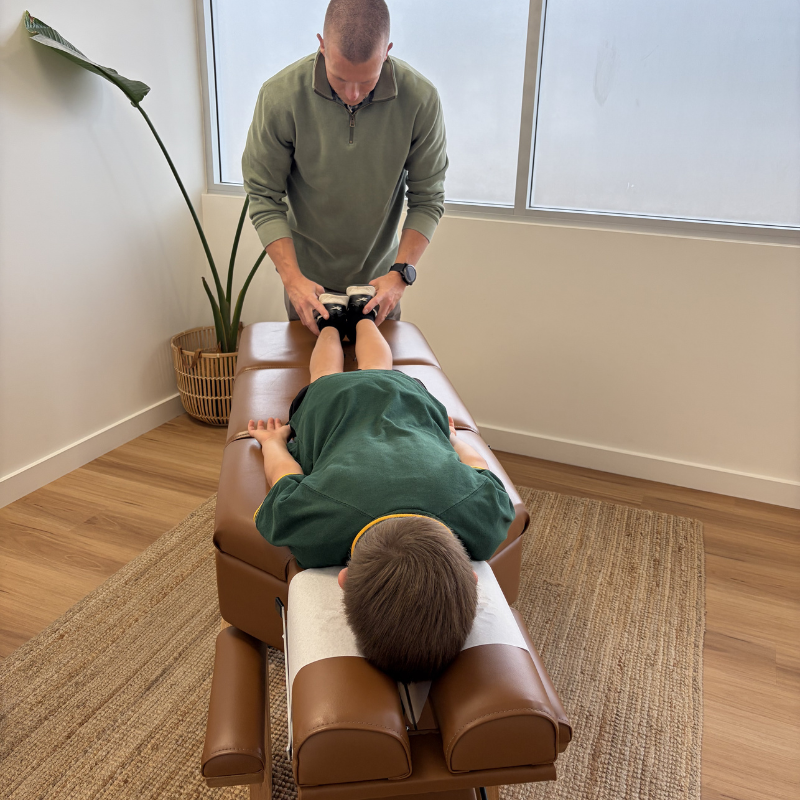
A neurologically focused chiropractic assessment considers the child’s history alongside their movement, spinal and joint function and relevant aspects of nervous system function.
Our Neurological INSiGHT Scans can also provide information about patterns associated with autonomic activity, muscle activity and temperature along the spine.
Depending on the assessment, this may include:
Heart Rate Variability (HRV) — providing information about variation between heartbeats and aspects of autonomic activity.
Surface electromyography (sEMG) — measuring patterns of muscle activity along the spine.
NeuroThermal scanning — measuring temperature patterns along the spine.
The scans don’t diagnose ADHD, sensory processing disorders, developmental conditions or problems with motor planning.
They provide additional information about nervous system and neurospinal function, which we consider alongside the child’s history and chiropractic examination.
Where Neurologically Focused Chiropractic Care Comes In
Our focus at Coast is the neurospinal system.
Where our assessment indicates chiropractic care is appropriate, gentle and specific adjustments are tailored to the individual child and their findings.
We can then reassess aspects of neurospinal function over time and objectively observe the measures we’re tracking.
We’re not promising to turn an energetic child into a quiet one.
And we wouldn’t want to.
Energy, enthusiasm, movement and a drive to explore are wonderful parts of childhood.
We’re interested in something much more nuanced:
How is this child’s neurospinal system functioning, and how well are they adapting to the different demands placed on them?
Because the goal isn’t a child who never presses the accelerator.
It’s a nervous system capable of changing gears.
Look Beyond the Speed
If your child is the one who never stops moving, you don’t necessarily need to ask:
“How do I get them to slow down?”
Try asking different questions.
How do they move when precision is required?
How do they cope when the pace changes?
What happens when they need to transition from high activity to something quieter?
How does their movement change when they’re tired?
What patterns do we see when we actually assess their neurospinal function?
Sometimes there’s much more information underneath all that movement than we realise.
At Coast Family Chiropractic, we take a neurologically focused approach to assessing children, teenagers and families.
If you’re curious about your child’s movement, adaptability or neurospinal function, contact our team to arrange an initial consultation and Neurological INSiGHT Scans.
All gas isn’t necessarily the problem. The interesting question is whether the nervous system can change gears when it needs to.